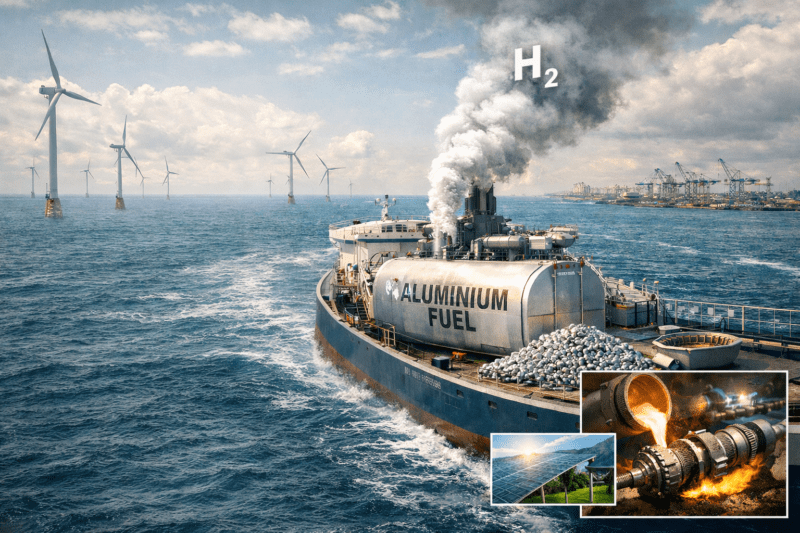
Joakim Haraldsson, a researcher at Lund University, proposes that aluminum could serve as a sustainable fuel for maritime transport, potentially reducing CO2 emissions. He explains that renewable energy can be stored in aluminum during its production and later released through oxidation on ships, either by burning or reacting with water. This process generates heat and hydrogen, which can power engines or turbines.
However, a challenge arises due to aluminum forming a thin oxide layer when exposed to air or water, which slows the reaction. Solutions include powdering the metal, adding chemical agents, or applying heat. The by-products from these reactions would be collected on ships and transported back to ports for conversion back into aluminum via electrolysis, creating a closed-loop system that would require new port infrastructure.
The International Maritime Organization aims for climate-neutral shipping by 2050, but existing alternative fuels face limitations. Although aluminum has a higher energy storage capacity than methanol and ammonia, it is heavier than fuel oil. Replacing fuel oil in global shipping would necessitate approximately 300 million tonnes of aluminum annually, significantly exceeding current production levels.
Currently, global shipping consumes around 2,560 TWh of fossil fuel energy annually, emitting approximately 699 million tonnes of CO2. This contributes to about 3% of global greenhouse gas emissions and releases harmful pollutants like sulfur and nitrogen oxides. Haraldsson emphasizes that this research is preliminary, and further studies are needed before aluminum can be commercially utilized as a fuel in shipping.
Share it now