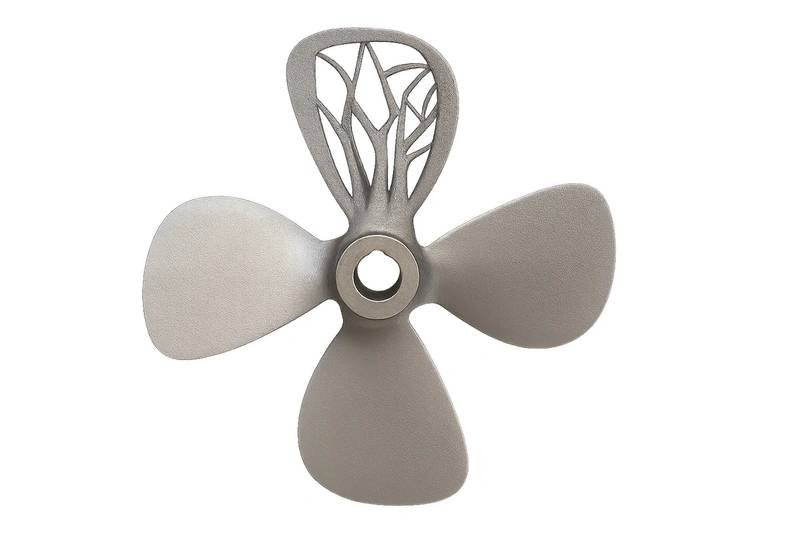
The Digitally Enabled Efficient Propeller (D.E.E.P) project, spearheaded by an industry consortium and funded by Innovate UK, aims to develop a new generation of marine propellers through advanced additive manufacturing (AM) techniques and digital twin technology. This innovation seeks to transform traditional propellers into intelligent, cyber-physical systems that can monitor their performance throughout their operational lifespan.
Secured through the Clean Maritime Demonstration Competition (CMDC6), the project will conduct a Techno-Economic Feasibility Study to explore the readiness of various AM processes for the complex maritime sector. It will benchmark these processes against conventional casting methods and establish a pathway for classification approval and type certification, ensuring both technical innovation and regulatory compliance.
Enki Marine leads the consortium, which includes experts from Stone Marine Propulsion, TWI, DEEP Manufacturing Ltd, Authentise, ASTM International, and Newcastle University. Each partner brings vital expertise, from design and materials testing to digital monitoring and hydrodynamic modeling. Peter Richards, CEO of DEEP Manufacturing, highlighted the project’s potential to utilize their experience in Wire Arc Additive Manufacturing (WAAM) to drive transformative manufacturing practices in the industry.
The D.E.E.P project is set to commence in September 2025, beginning with an evaluation of AM processes. Future phases will involve validating the demonstrator on Newcastle University’s research vessel, ultimately aiming for type approval and scaling production for global commercial use.
Share it now