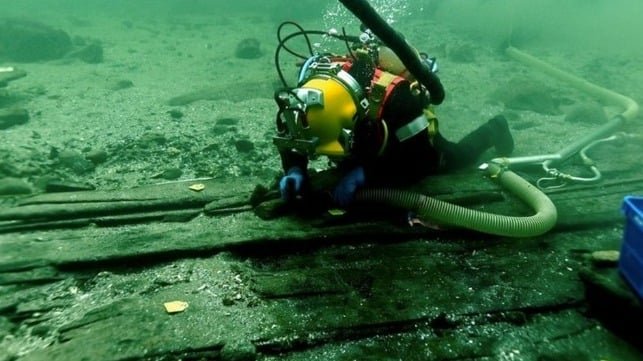
A team of archaeologists from the Viking Ship Museum in Denmark has made a remarkable discovery: the largest medieval cargo ship ever found in Europe. The wreck was uncovered in the Oresund while the team was investigating the seabed for the construction of Lynetteholm, a controversial manmade island near central Copenhagen. This new 270-acre development aims to serve as a harbor protection feature against storm surges and will also create a new urban area.
The ship, named Svaelget 2, measures approximately 100 feet in length and 30 feet in width, dating back to the early 1400s. Although no cargo was retrieved, numerous personal items belonging to the crew were found at the site. The vessel’s substantial deadweight of around 300 tonnes indicates its role in long-distance trade within the expanding maritime network of the time, facilitating the transport of bulk goods like salt, timber, and food.
The construction of the ship involved materials sourced from different regions, with planks from Poland and ribs from the Netherlands. This suggests that Polish timber was likely transported to Dutch shipyards for assembly. The wreck’s extraordinary preservation includes remnants of rigging and a unique raised deckhouse, marking a significant advancement over earlier Viking designs. Additionally, the ship featured an advanced galley equipped with a brick hearth, showcasing its role in facilitating longer voyages across challenging waters.
Related posts:
 Record Offshore Oil and Gas Reserves Discovered Near Poland’s Baltic Coast
 Innovative Methanol-Fuel Cell System by PowerCell Gets DNV Approval
 Lloyd’s Register Partners with Microsoft to Use AI for Nuclear Power Regulation in Maritime Industry
 ABS Awards First CR-Ex Cyber Resilience Notation Certificate