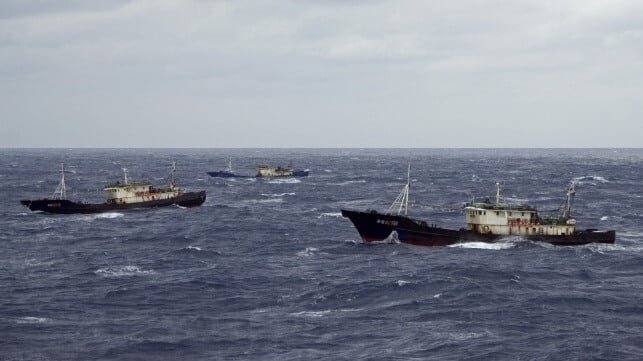
South African authorities recently intercepted and fined four Chinese fishing vessels suspected of illegal fishing activities. These vessels, identified as Zhong Yang 231, Zhong Yang 232, Zhong Yang 233, and Zhong Yang 239, entered South Africa’s Exclusive Economic Zone (EEZ) without the necessary permits and reportedly manipulated their automatic identification systems (AIS) by switching them on and off.
The vessels, owned by Shenzhen Shuiwan Pelagic Fisheries Co., initially sought permission for “innocent passage” through the EEZ on February 23, claiming they would exit by March 3. However, a subsequent request for off-port limits (OPL) authorization was made on February 27 without proper justification, leading to its rejection. Investigations revealed the vessels had already entered South African territorial waters while the OPL request was pending, prompting authorities to track their movements along the KwaZulu-Natal and Eastern Cape coastlines.
In response, South Africa’s Department of Forestry, Fisheries and the Environment, in collaboration with local police, executed a coordinated operation that led to the vessels’ detention at the Port of Cape Town. The masters of the vessels were charged for violating the Marine Living Resources Act and fined $24,118, which was paid by the vessel’s owner, allowing their release. Minister Willie Aucamp emphasized South Africa’s commitment to protecting its maritime zones and resources against illegal activities.
With a coastline of approximately 3,000 kilometers, South Africa faces significant challenges from illegal, unreported, and unregulated (IUU) fishing, particularly from Chinese distant-water fleets. The World Wildlife Fund estimates that South Africa, along with Kenya, Madagascar, Mozambique, and Tanzania, loses up to $142.8 million annually due to illegal fishing of key species like shrimp and tuna.
Share it now