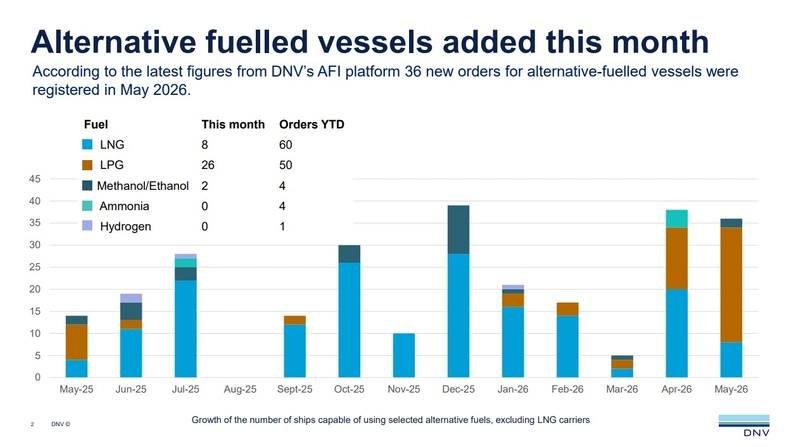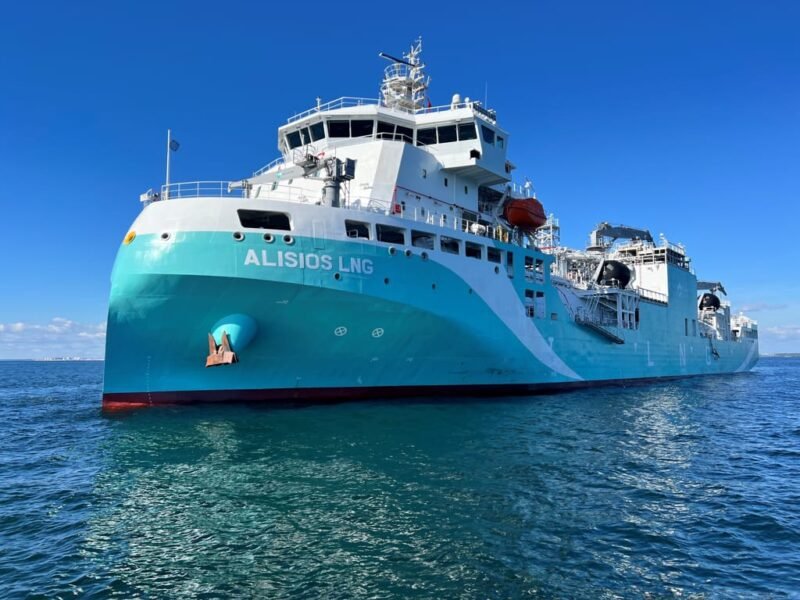
SEA-LNG reports that liquefied natural gas (LNG) remains the leading choice for orders of alternatively fueled ships amid the industry’s efforts to lower greenhouse gas emissions. According to their 2026 Mid-Year Market Review, LNG dual-fuel vessels accounted for 73 new orders in the first half of the year, making up nearly 90% of all alternative vessel orders monitored by DNV. The report also reveals a continued investment in bunkering infrastructure, with 67 LNG bunker vessels currently operational and an additional 42 on order.
LNG orders are primarily focused on liner shipping, particularly containerships and pure car and truck carriers (PCTCs). A World Shipping Council analysis mentioned in the report indicates LNG constitutes 58% of container ship tonnage ordered, surpassing the 36% allocated for conventionally fueled ships. Fuel demand has risen in tandem with fleet growth, with global LNG bunker volumes averaging around 770,000 cubic meters monthly from January to May 2026, a 13% increase from the same timeframe last year.
Additionally, the coalition is witnessing an increase in liquefied biomethane (LBM), or bio-LNG, suitable for existing LNG-fueled vessels. European biomethane capacity reached 8.2 billion cubic meters annually by the end of Q2, a 17% rise year-over-year, with operational biogas plants growing from 1,678 to 1,975. Despite uncertainties, SEA-LNG’s COO, Steve Esau, asserts that the industry is advancing in its methane decarbonization efforts.
Founded in 2016, SEA-LNG has significantly expanded, with LNG-fueled vessels increasing from 81 to over 1,550 in the last decade. The number of LNG bunker vessels has grown from nine to 109, and ports offering LNG bunkering have expanded from 10 to 222 globally. While there is ongoing debate about LNG’s long-term role in maritime decarbonization, proponents argue it facilitates a transition toward lower-carbon fuels, while critics caution against methane slip and upstream emissions impacting its climate advantages compared to zero-emission fuels like ammonia or hydrogen.