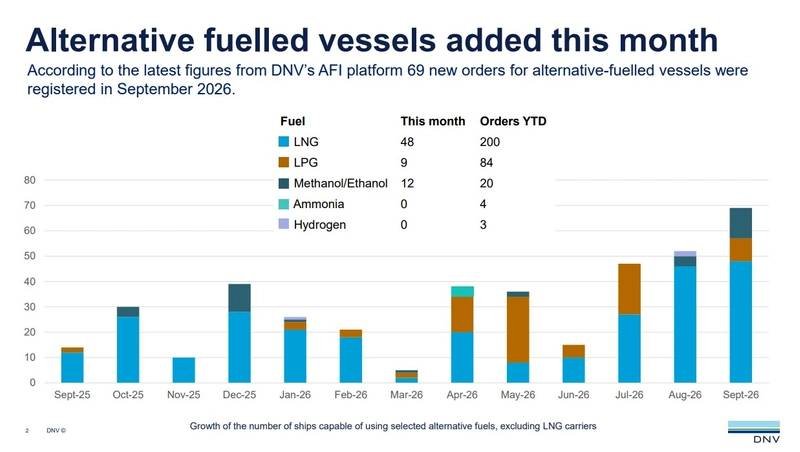
The shipping industry is under pressure as it approaches a critical 2030 goal for adopting zero-emission fuels. Despite advancements in methanol infrastructure and alternative fuel vessel capacity, a recent report from the UCL Energy Institute and Getting to Zero Coalition highlights significant disparities in progress. The adoption of the International Maritime Organization’s Net-Zero Framework is central to this issue; while it was agreed upon in principle last year, formal acceptance remains pending, leaving industry stakeholders uncertain about future regulations.
This uncertainty has led to a decline in interest and investment in zero-emission technologies. For instance, the percentage of zero-emission fuel-capable vessels in the global orderbook has dropped from 9.5% to 5.7% over the past year, alongside a reduce in shipping-specific sustainable debt issuance from $3.4 billion to $3 billion. Although the infrastructure for alternative fuels, such as methanol, has expanded—evidenced by an increase in ports offering methanol bunkering—there is still insufficient demand to catalyze large-scale investments.
As the industry aims to achieve that 2030 benchmark, which seeks zero-emission fuels to comprise 5% to 10% of international shipping fuel consumption, five key areas are evaluated. Although technology and civil society engagement show progress, demand, finance, and policy remain significantly off track. With formal negotiations on the Net-Zero Framework imminent, the shipping sector faces a crucial decision-making period about future investments and technologies, all while navigating a complex regulatory landscape.