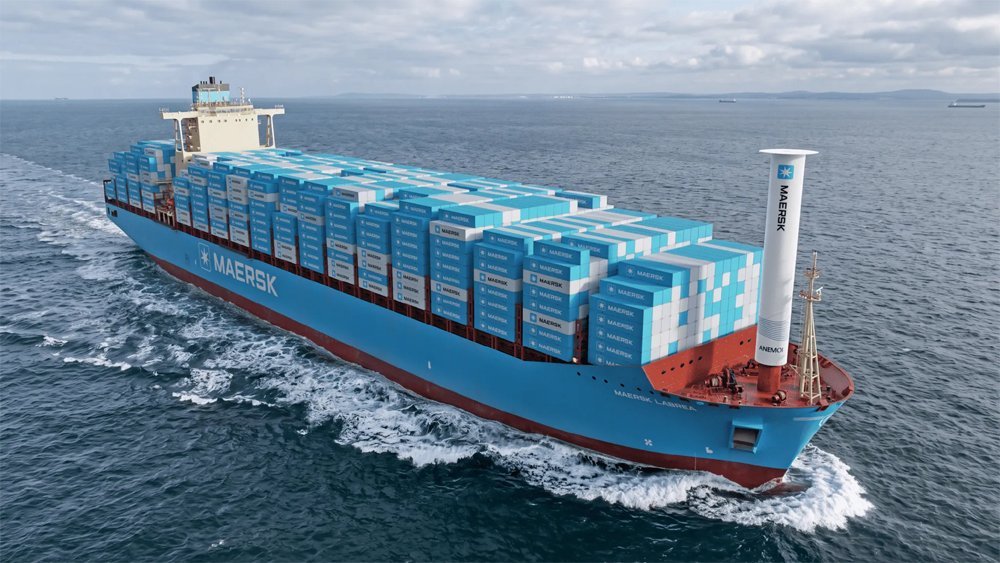
Maersk, in collaboration with British wind propulsion firm Anemoi, is set to explore wind-assisted propulsion on one of its smaller containerships. While the shipping industry has previously focused on rigid sails, this initiative marks the first implementation of a wind rotor on boxships. The aim is to enhance efficiency and lower emissions and costs. Anemoi will design and manufacture a 5-meter-diameter, 35-meter-tall fixed Rotor Sail, which is scheduled for retrofitting in mid-2027. This system will be integrated with existing onboard systems, with Anemoi providing engineering and installation support.
The rotor will be installed on a Maersk Lima class vessel, which is expected to operate on North and South Atlantic routes. The Lima class consists of 16 vessels delivered from 2011, each measuring 300 meters in length and capable of carrying around 8,700 TEU. Anemoi noted that the limited deck space on containerships has hindered the adoption of wind-assisted propulsion, as most deck area is occupied by containers. This pilot addresses those concerns by positioning the rotor near the bow and using a fixed design to minimize interference with cargo operations.
Anemoi believes that containerships are ideal candidates for this technology due to their predictable routes and operating conditions. The rotor can function effectively in heavy seas and high wind speeds. Ole Graa Jakobsen, Maersk’s Head of Fleet Technology, emphasized that wind-assisted propulsion represents a promising solution for improving vessel efficiency and reducing emissions. Anemoi’s rotor technology, which utilizes the Magnus effect, can potentially reduce fuel consumption and emissions by 5 to 30 percent.
Currently, there are around 110 commercial installations of wind-assisted propulsion on vessels over 400 gross tons, with additional units on order and more in development. Various technologies, including rigid sails and rotors, have been tested across different ship classes. Meanwhile, an EU-funded project is evaluating a rigid sail concept on a containership, and Ocean Network Express is exploring portable wind-assisted propulsion solutions for its fleet.